

HOW THE GOVERNMENT PLANS TO ACHIEVE NET ZERO CARBON EMISSIONS BY 2050
AND THE IMPACT THIS WILL HAVE ON OUR LIVES.
Background
The UK Carbon Budgeting Process is a legal requirement on the UK Government under Section 34 of the 2008 Climate Change Act. This requires the UK to meet net zero carbon emissions by 2050.
The UK Government Climate Change Committee produced a recommendation on February 26th 2025 to government for the amount of UK carbon emissions permitted over a five year period, 13 years in advance of the start of budget period, and a ‘pathway’ of actions on how it can be delivered. Parliament have to either accept or amend the proposed target emissions of 535 million tonnes of CO2 for the 7th carbon budget period 2038-2042 by October 29th 2025.
The first 3 five year budgets covering 2008 to 2022 have been achieved. The next 3 five year budgets covering 2023-2037 have been agreed and legislated for.
The main actions proposed to deliver the carbon budgets for future years are:
- Phasing out of using gas for electricity generation and its replacement with renewables, mainly wind and solar, and some new nuclear power stations, all with the aim of increasing generating capacity in total.Upgrading of the electricity transmission network and an increase in the provision of flexible storage systems, primarily batteries, but also pumped hydro and two way high voltage interconnectors with neighbouring countries. These are to provide resilience in times when the sun doesn’t shine and the wind doesn’t blow and also to efficiently absorb surplus renewable energy when the opposite happens.
- Steadily replacing petrol and diesel cars, vans, trucks and buses with electric vehicles (EVs) so that by 2040 75% of cars and vans and 67% of HGVs on the road will be EVs. It is expected that new EVs will be price competitive with petrol and diesel vehicles by 2026-2028 with the rapid development of more efficient battery technologies. These efficiencies will reduce the cost and increase the range on a single charge as well as permit more rapid charging.
- By 2040 it is planned to have half of all UK houses powered by heat pumps and 61% of industry powered by heat pumps, electric boilers or furnaces, based on replacing existing equipment (mainly gas powered) when they are life expired.
- To counter agricultural emissions the main measures proposed are tree planting and peat bog restoration. Woodland cover would need to increase from 13% (now) to 16% by 2040 and the proportion of UK peatland that is restored/rewetted would need to increase from 26% in 2023 to 55% by 2040.
- There will also be increases in energy efficiency through home insulation, reduction in waste and improved technology.
The main behavioural changes expected to be needed are:
- Encouraging the use of walking, cycling and public transport to reduce driving.
- A reduction of 25% in meat consumption, particularly beef and lamb, by 2040. This assumes continuation of existing trends among the population.
- Aviation to bear more of the costs of mitigating their own carbon emissions to reduce flying demand.
- None of these proposals are unrealistic or require huge sacrifices by people.
Can we afford it?
There is an upfront cost of investment (not primarily because of net zero) but because we have not adequately invested in our infrastructure in recent decades. We would still need new power stations and upgraded transmission systems regardless. The difference is replacing fossil fuels with electrification investment has a financial payback compared to continuing with fossil fuels. We would all benefit economically, have cleaner air and a more secure energy supply. By 2040 the capital and operating costs that have been spent up to that date on net zero would have been paid back and beyond that the financial benefits would continue to increase.
The recommended Seventh Carbon Budget
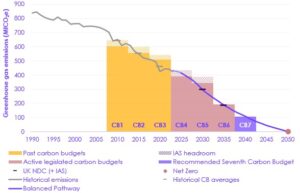
Source: The 7th Carbon Budget issued by the UK Government Climate Change Committee
https://www.theccc.org.uk/publication/the-seventh-carbon-budget/