

PLUG IN SOLAR PANELS and GULLY UNDER PAVEMENT ELECTRIC VEHICLE CHARGING
1. Background
The UK Government announced two new initiatives to expand the availability of renewable power to households to help people who are unable for whatever reason to install traditional roof top Solar or don’t have off street parking for an electric vehicle as a response to the increase in energy because of the Middle East Conflict.
2. Plug-in Solar Panels
These are very popular in Germany in particular and many other European Countries. These can be bought in those countries from supermarkets and online stores such as Amazon.
Since the European Electricity Grid works on the same technology as the UK Grid i.e 230 volts and 50 hertz (cycles per second AC) There is no intrinsic reason why plug in solar should not be permitted in the UK. To achieve this the government will need to consult with the various electricity distributors and safety bodies and get the UK standards and rules amended to legalise their use by UK Households.
This they hope to achieve by the end of Summer 2026.
The proposal is to permit certificated plug in solar kits to be self-installed by households in the UK.
The proposed limit would be a system with a maximum solar generation of 800 watts (approximately 3 amps.) which is well within the limits of a household ring main.
How does plug in solar work?. The solar panels have simple connectors that plug into a micro inverter (which is necessary to convert DC electricity from the solar panel(s) to AC household electricity. The micro inverter has a standard UK Cable and Plug which fits into a household socket, so it is plug and go. There is no need for an MCS qualified electrician to install it. If your electrical system or fuse box is old it would be worth checking with an electrician to ensure no problems arise.
A plug in solar unit is not a real alternative to a rooftop solar system as it has a lot less generating capacity and will not have the ability to store power for use later or access export tariffs – but it will benefit households that cannot afford a rooftop system as a plug in solar system will retail for hundreds rather than thousands of pounds. It would be possible to get a payback in 3 to 4 years.
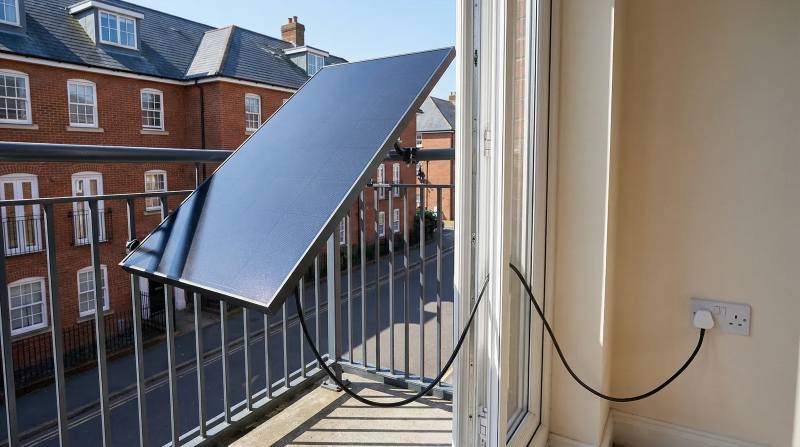
Many people live alone and have relatively low electricity usage and this sort of system will be of benefit. In any household there always some continuous demand for electricity e.g Broadband routers, TVs, computers, fridge freezers etc that still use power 24/7 This in typically of the order of 100-200 watts continuously and will also make a contribution to the power used by other appliances.
Any surplus generation not being used by the house will be automatically exported safely back to the grid. So the art is to use the power that is being generated at the time. An advantage on a sunny day is that you can move it around to better align with the sun over the day.
So expect to see such plug in solar kits available in the Lidl middle aisle in the not too distant future.
3. Gully (under pavement) electric vehicle charging.
Devon County Council are one of 35 highway authorities that currently allow this.
For the cost of a £600-700 you can use an approved contractor such as Kerbocharge to install the gully in the pavement which you can connect to a home EV charger hence benefitting from overnight cheap electricity charging at a few pence per kilowatt (2p a mile from a typical EV). Public chargers typically charge about 10 times that so eliminating much of the financial benefit of driving an EV. for households without off street parking. Gully charging is particularly financially beneficial for terraces where people have to park on the road in front of their houses. Check with Devon County Council the process for approval and which are approved contractors and if there are any grants to reduce the cost of installation. To use such a system to plug in an EV unpeel the resealable detachable cover over the gully and lay the charger cable in the gully with one end plugged into the home charger and the other end in the car EV socket, then reseal the gully so that it is safe for users of the pavement. When sealed it is flush with the pavement surface. The same procedure applies when unplugging the car charger.
Download pdf Plug-in solar & street charging