Terminology

Sometimes the terms used in connection with the climate emergency can create confusion or uncertainty and are quite often misused. Here we try to explain a few of the basics, along with providing some links to areas of knowledge that may also enhance understanding.

Climate Change refers to the long-term shifts in temperatures and weather patterns. Such shifts can be natural, due to changes in the sun’s activity or large volcanic eruptions. But since the 1800s, human activities have been the main driver of climate change, primarily due to the burning of fossil fuels like coal, oil and gas. This is often called Anthropogenic Climate Change (ACG)  (i.e. change caused by human activity).
Global Warming (or Global Heating) is the rise in the average temperature of the Earth's surface, which leads to climate change. The average temperature of the Earth’s surface is now (2024) about 1.1°C warmer than it was in the late 1800s (before the industrial revolution) and warmer than at any time in the last 100,000 years. The last decade (2011-2020) was the warmest on record, and each of the last four decades has been warmer than any previous decade since 1850.

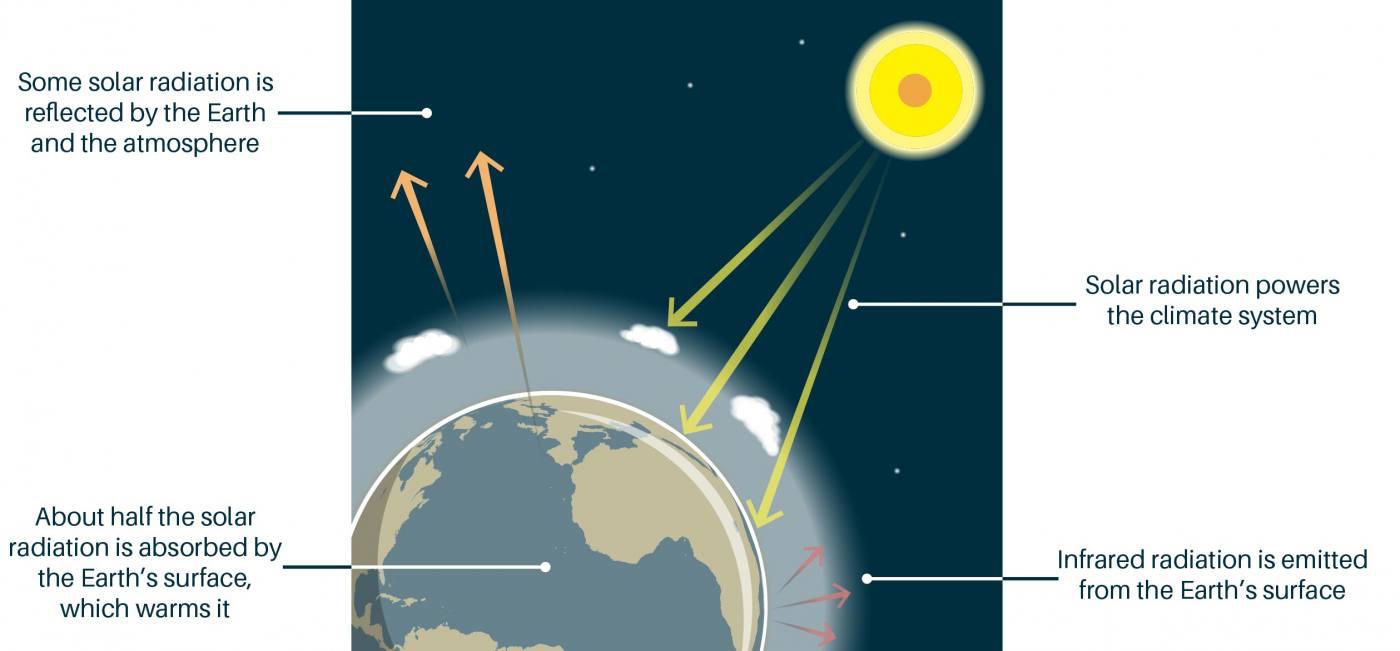
Greenhouse Gases are those gases in the atmosphere – such as carbon dioxide (CO2), methane (CH4) or nitrous oxide (N20) – that contribute to the Greenhouse Effect.


The greenhouse effect: some of the infrared radiation from the Sun passes through the atmosphere, but most is absorbed and re-emitted in all directions by greenhouse gas molecules and clouds. The effect of this is to warm the Earth’s surface and the lower atmosphere.  BGS © UKRI.

Since the start of the Industrial Revolution in the mid-18th century, human activities have greatly increased the concentrations of greenhouse gases in the atmosphere. Consequently, measured atmospheric concentrations of CO2 are many times higher than pre-industrial levels.

IPCC is the Intergovernmental Panel On Climate Change - the United Nations body for assessing the science related to climate change. It was established in 1988 to provide policymakers with regular scientific assessments on the current state of knowledge about climate change. The Sixth Assessment Report, the latest (at 2024) was finalized in 2023

Visit the IPCC Website

Net Zero is the term extensively used to describe the condition where the amount of greenhouse gases (GHGs) that are removed from the atmosphere is equal to those emitted by human activity.

CABH has produced an article on Net Zero which can be found HERE

Carbon Neutral means having a balance between emitting carbon and absorbing carbon from the atmosphere in carbon sinks. Removing carbon dioxide from the atmosphere and then storing it is known as carbon sequestration. In order to achieve net zero emissions, all worldwide greenhouse gas (GHG) emissions will have to be counterbalanced by carbon sequestration.

A carbon sink is any system that absorbs more carbon than it emits. The main natural carbon sinks are soil, forests and oceans.

Renewable Energy is energy derived from natural sources that are replenished at a higher rate than they are consumed. Sunlight and wind, for example, are such sources that are constantly being replenished. Renewable energy sources are plentiful and all around us.

Fossil fuels - coal, oil and gas - on the other hand, are non-renewable resources that take hundreds of millions of years to form. Fossil fuels, when burned to produce energy, cause harmful greenhouse gas emissions, such as carbon dioxide.

Generating renewable energy creates far lower emissions than burning fossil fuels. Transitioning from fossil fuels, which currently account for the lion’s share of emissions, to renewable energy is key to addressing the climate crisis.

Renewables are now cheaper in most countries, and generate three times more jobs than fossil fuels.

Carbon Offset is a means of offsetting your carbon emissions by paying towards projects that remove carbon dioxide and other greenhouse gases from the atmosphere elsewhere. This means you effectively reduce your carbon emissions.

CABH has produced an article on carbon offset which can be found HERE

A Carbon Footprint (or greenhouse gas footprint) is a calculated value or index that makes it possible to compare the total amount of greenhouse gases that an activity, product, company or country adds to the atmosphere. Carbon footprints are usually reported in tonnes of emissions (CO2-equivalent) per unit of comparison